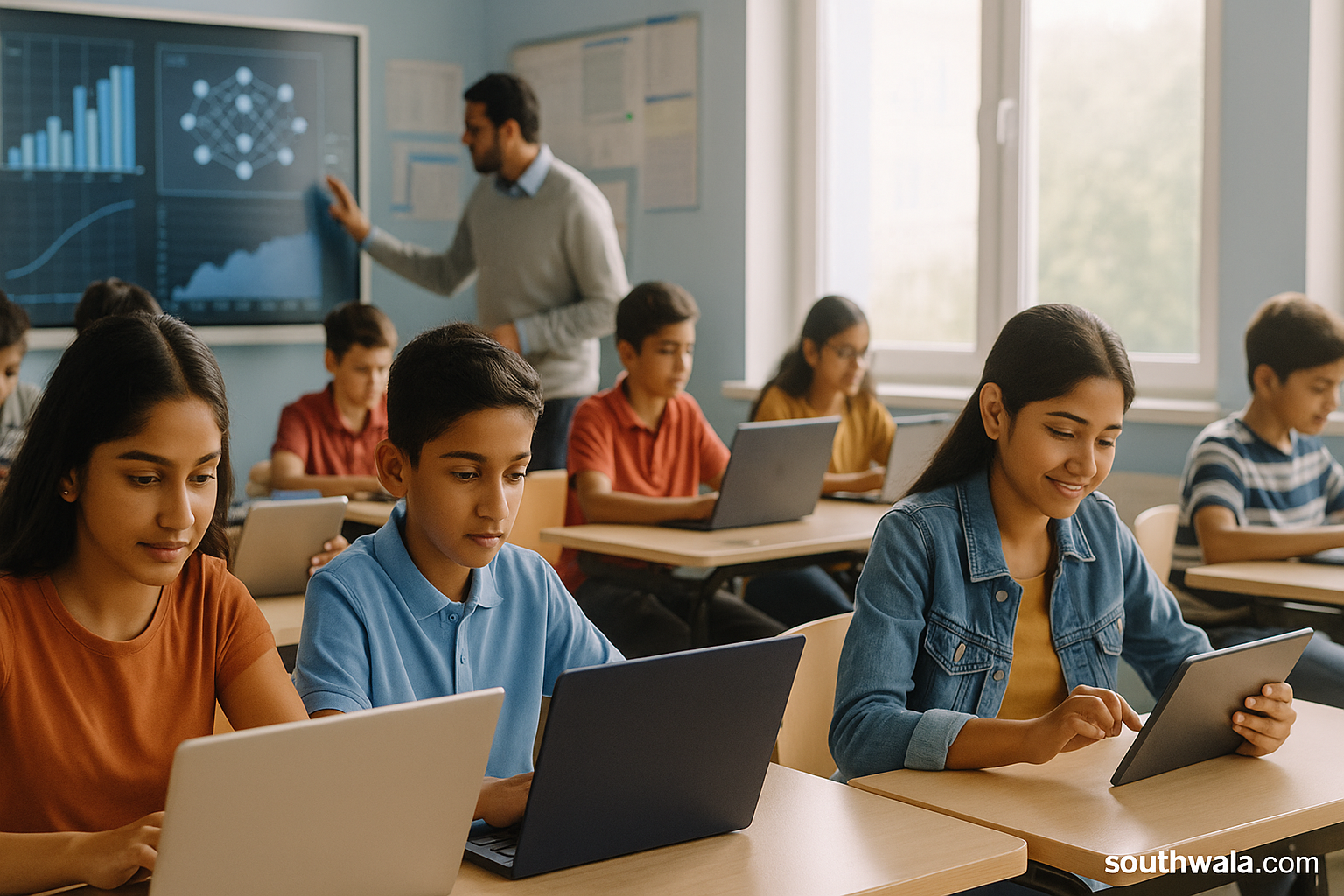
Southwala Shorts
- One of the biggest benefits of AI in education is personalisation.
- In a regular classroom, every student is expected to learn at the same pace.
- But AI-powered platforms like Khan Academy’s AI tutor or Duolingo change the lesson speed based on how quickly you understand the topic.
- If you learn something fast, AI moves you ahead.

Highlights
- AI is changing how students study, revise, and access information
- Learning can now be personalised for each student’s needs
- Teachers use AI to track performance and give better feedback
- AI helps students with learning difficulties and language barriers
- The classroom of the future will combine teachers and AI tools
One of the biggest benefits of AI in education is personalisation. In a regular classroom, every student is expected to learn at the same pace. But AI-powered platforms like Khan Academy’s AI tutor or Duolingo change the lesson speed based on how quickly you understand the topic.
If you learn something fast, AI moves you ahead. If you struggle, it gives more examples and practice. This way, quick learners are not slowed down and those who need more time are not left behind.
Smarter Feedback for Better Learning
AI can give instant feedback. Instead of waiting days for a teacher to check your work, AI tools can spot mistakes immediately.
For example, an AI writing app can underline grammar errors, suggest better words, and explain why your sentence could be improved. This helps students correct themselves on the spot and learn faster.
Breaking Language and Accessibility Barriers
AI is making learning easier for students who face extra challenges.
- Language translation tools help students study in their own language.
- Text-to-speech and speech-to-text help those with reading or writing difficulties.
- AI tutors are available any time of the day, so learning is not limited to school hours.
This is especially helpful for students in rural areas or those who cannot always go to well-equipped schools.
Helping Teachers, Not Replacing Them
Many people worry that AI will take away teaching jobs. That is not true. AI cannot replace the human care, motivation, and life lessons that a teacher gives.
What AI can do is handle repetitive work like grading assignments, checking attendance, or tracking marks. This gives teachers more time to focus on guiding students, encouraging them, and making lessons interesting.
The Classroom of the Future
In the coming years, AI will become a normal part of schools. Students might use virtual reality headsets to see history lessons come alive or to explore science experiments in 3D.
AI will also help teachers notice which students are falling behind and offer extra support before it becomes a big problem.
AI in education is more than just a new trend. It is changing learning to be more personal, more flexible, and more accessible. The best results will come when AI works side by side with teachers, combining human understanding with machine precision.
FAQs
1. How is AI used in schools?
It is used for personalised lessons, quick grading, and language translation.
2. Can AI replace teachers?
No, it supports teachers but cannot replace the personal connection they bring.
3. Does AI help slow learners?
Yes, it adapts lessons to each student’s pace and offers extra help when needed.
4. Is AI only for online classes?
No, it is used in both physical classrooms and online learning.
5. Will AI make education costly?
Not always. Many AI tools are free or low-cost and can make good learning accessible to more people.
Author


Discover more from Southwala
Subscribe to get the latest posts sent to your email.