Southwala Shorts
- Earth feels like a safe and welcoming home compared to the rest of our solar system.
- Out there, beauty often hides danger.
- Some planets and moons are so hostile that a human would die in seconds.
- The threats include intense heat, freezing cold, poisonous atmospheres, violent volcanic activity, and radiation strong enough to destroy cells instantly.

Earth feels like a safe and welcoming home compared to the rest of our solar system. Out there, beauty often hides danger. Some planets and moons are so hostile that a human would die in seconds. The threats include intense heat, freezing cold, poisonous atmospheres, violent volcanic activity, and radiation strong enough to destroy cells instantly. These places may be deadly, but they are also fascinating because they teach us how extreme planetary environments can get.
Venus : The Planet That Can Melt Metal
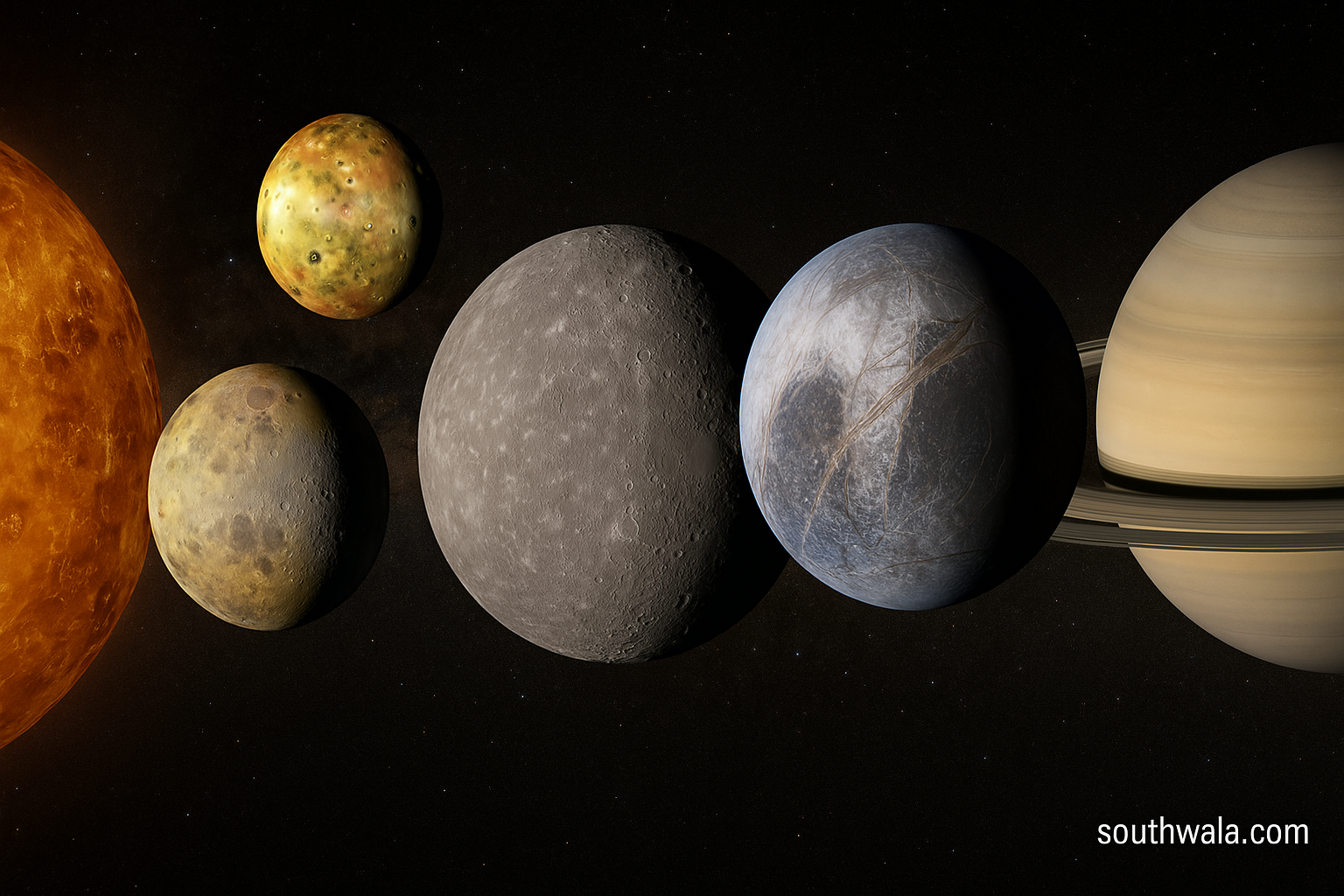
Venus is often called Earth twin because of its size, but that is where the similarity ends. Its atmosphere is made almost entirely of carbon dioxide, with thick clouds of sulfuric acid. The surface temperature reaches about 475°C, which is hotter than the inside of a pizza oven and hot enough to melt lead. The air pressure is 92 times higher than Earth’s, similar to being nearly a kilometer underwater. Even the toughest spacecraft sent by humans, like the Soviet Venera landers, survived for only a short time before they were crushed and destroyed by the heat.
Io : The Moon That Never Sleeps
Io, one of Jupiter largest moons, is the most volcanically active place we know. Its surface is covered with hundreds of active volcanoes, lava lakes, and giant fountains of molten rock that can shoot kilometers into the sky. The extreme activity is caused by Jupiter’s immense gravity pulling and stretching Io’s interior. Standing on Io would be impossible for a human without advanced protection because you would be surrounded by boiling lava, toxic sulfur gases, and constant earthquakes. On top of that, Io is bathed in intense radiation from Jupiter’s magnetic field, which would be lethal in minutes.
Mercury : The Planet of Fire and Ice
Mercury, the closest planet to the Sun, has no thick atmosphere to protect it. This causes some of the most extreme temperature changes in the solar system. During the day, the surface can heat up to about 430°C, hot enough to boil many metals. At night, temperatures drop to -180°C, which is colder than Antarctica’s winter. This planet is also exposed to harmful solar radiation with no atmospheric shield. Any human or spacecraft would need extraordinary heat and cold protection to survive.
Europa : An Ocean Under Ice
Europa, another moon of Jupiter, is one of the most beautiful worlds in the solar system. Its surface is a sheet of ice that stretches for thousands of kilometers. Beneath it lies a deep, salty ocean that may hold more water than all of Earth’s oceans combined. Scientists think Europa’s ocean could support life, but getting there is the challenge. The surface is blasted with radiation from Jupiter strong enough to kill a human in a single day without heavy shielding. The ice itself is cracked, constantly shifting, and may have hidden geysers shooting water into space.
Saturn’s Rings : A Deadly Debris Field
From far away, Saturn’s rings look peaceful and delicate. In reality, they are made of billions of pieces of rock and ice, some as small as grains of sand and others as large as mountains. These particles orbit Saturn at tremendous speeds. Any spacecraft trying to pass through without extreme shielding would be torn apart by collisions. The rings are a beautiful but dangerous cosmic graveyard.
The solar system is filled with wonders, but many of its most spectacular places are also the most dangerous. Venus can crush and burn anything on its surface, Io is in constant volcanic chaos, Mercury swings between deadly heat and freezing cold, Europa hides its secrets behind lethal radiation, and Saturn’s rings could shred anything that tries to cross them. These worlds remind us just how rare and precious Earth’s environment is. Studying them helps scientists prepare for future exploration and deepens our understanding of how planets and moons evolve.
Author


Discover more from Southwala
Subscribe to get the latest posts sent to your email.