Southwala Shorts
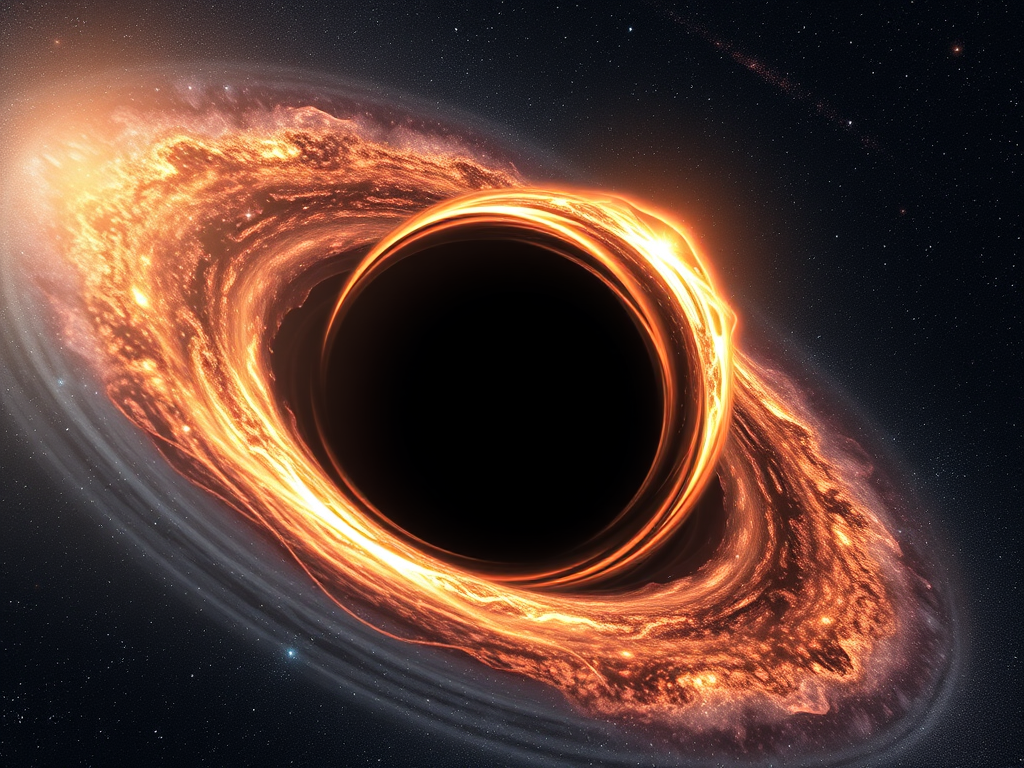
- A black hole is one of the strangest objects in the universe.
- It is formed when a very massive star runs out of fuel and collapses under its own gravity.
- The pull of gravity becomes so strong that nothing can escape from it, not even light.
- That is why it is called a “black” hole.

A black hole is one of the strangest objects in the universe. It is formed when a very massive star runs out of fuel and collapses under its own gravity. The pull of gravity becomes so strong that nothing can escape from it, not even light. That is why it is called a “black” hole.
At the center of a black hole is what scientists call a singularity a point where matter is squeezed to infinite density. Surrounding it is the event horizon, the boundary beyond which nothing can return. If anything crosses this boundary a star, a planet, or even light. it is lost to the outside universe.
Black Holes and Information
In science, “information” refers to the details about the physical state of matter – for example, what atoms make up a star, how they are arranged, and how energy flows. When an object falls into a black hole, it seems that all this information disappears.
But physics has a problem with that idea. According to the laws of quantum mechanics, information in the universe cannot be destroyed. This puzzle is called the Black Hole Information Paradox, and it has been a major area of research for decades.
Surprising Role of the Event Horizon
In the 1970s, physicist Stephen Hawking discovered that black holes are not completely black. They can emit tiny amounts of radiation, now called Hawking radiation. This radiation suggests that information may not be lost forever but could slowly leak out.
Another breakthrough came from the work of Jacob Bekenstein, who showed that a black hole’s ability to hold information is linked not to its volume, but to the area of its event horizon. In simple terms, the larger the surface area of the black hole, the more information it can store.
To measure storage, scientists use a unit called a bit the same unit used in computers. According to Bekenstein’s formula, a black hole can store about one bit of information per tiny unit of surface area called the Planck area.
For perspective:
- A black hole the size of a human cell could store more information than all the books ever written on Earth.
- A black hole with the mass of our Sun could hold around 10⁷⁷ bits of information – an unimaginably large number.
This makes black holes the ultimate information banks of the universe.
Understanding how black holes store and release information is not just about astronomy. It touches the foundations of physics itself the link between gravity, thermodynamics, and quantum mechanics. Black holes act like natural laboratories, forcing scientists to rethink the laws of the universe.
A black hole is not just a cosmic vacuum cleaner. It is also a record-keeper, storing unimaginable amounts of information on its surface. Thanks to discoveries by scientists like Hawking and Bekenstein, we now know that the secrets of the universe may be written on the “skin” of a black hole. The study of these mysteries continues to push science toward a deeper understanding of reality.
Author


Discover more from Southwala
Subscribe to get the latest posts sent to your email.