Southwala Shorts
- Section 279 of the Indian Penal Code deals with rash and negligent driving on public roads.
- It exists to hold drivers accountable when their driving endangers human life, causes injury, or risks damage to property.
- The provision is not limited to cars – it applies to any vehicle, including two-wheelers, trucks, buses, and even non-motorised vehicles like cycles if driven...
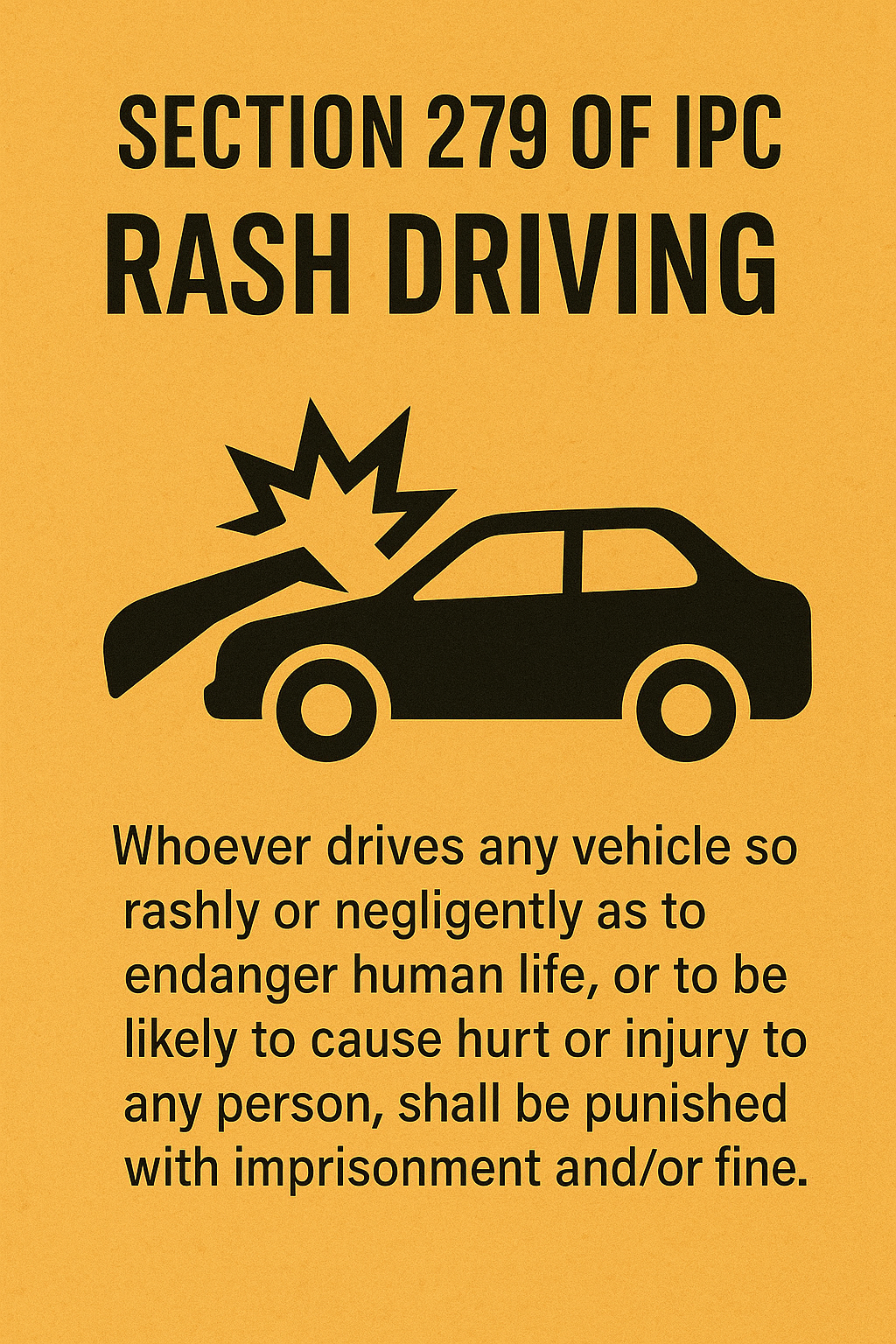
- “Whoever drives any vehicle, or rides, on any public way in a manner so rash or negligent as to endanger human life, or to be...

Section 279 of the Indian Penal Code deals with rash and negligent driving on public roads. It exists to hold drivers accountable when their driving endangers human life, causes injury, or risks damage to property.
The provision is not limited to cars – it applies to any vehicle, including two-wheelers, trucks, buses, and even non-motorised vehicles like cycles if driven dangerously.
What the Law Says
Section 279 states:
“Whoever drives any vehicle, or rides, on any public way in a manner so rash or negligent as to endanger human life, or to be likely to cause hurt or injury to any person, shall be punished with imprisonment up to six months, or with fine up to one thousand rupees, or both.”
Two essential elements must be proved:
- The act of driving on a public way.
- The manner of driving was rash or negligent enough to endanger life or cause injury.
Understanding “Rash” and “Negligent” Driving
- Rash Driving: Driving with the knowledge that your speed or manoeuvre is dangerous but doing it anyway, without regard for the consequences.
- Negligent Driving: Failing to take reasonable care while driving even at low speeds resulting in potential harm.
Example:
A driver swerving between lanes at high speed in a crowded market is rash driving.
A driver using a mobile phone and hitting a pedestrian at a slow speed is negligent driving.
Common Situations That Fall Under Section 279
- Driving above speed limits in residential areas.
- Jumping traffic signals recklessly.
- Overtaking dangerously without visibility.
- Driving under the influence of alcohol or drugs.
- Performing stunts on public roads.
How It Differs from Other Traffic Offences
Section 279 is a criminal offence, not just a traffic violation.
- Traffic challans usually result in fines.
- A Section 279 case can lead to arrest, trial, and imprisonment in addition to fines.
Example:
Running a red light may result in a fine under traffic rules. But if it causes an accident or endangers lives, the police can register a case under Section 279.
Punishment and Legal Process
- Imprisonment: Up to 6 months.
- Fine: Up to ₹1,000.
- Both penalties can be applied together.
Police can file a First Information Report (FIR), and the matter will be tried in a criminal court. Witness statements, CCTV footage, and accident reports are often used as evidence.
Example Cases from Real Life
- Case 1: A bus driver in Delhi was booked under Section 279 after overtaking from the wrong side and hitting a cyclist, causing serious injuries.
- Case 2: In Pune, a motorcyclist performing wheelies on a public road caused a pedestrian to fall. Even though no serious injury occurred, his actions were considered rash under Section 279.
Insights
Section 279 serves as a deterrent against careless driving by treating it as a criminal matter, not merely a traffic issue.
Drivers must understand that a public road is a shared space. The moment their actions cross the line from simple carelessness to behaviour that endangers life, they move into the territory of criminal liability.
Author


Discover more from Southwala
Subscribe to get the latest posts sent to your email.