Southwala Shorts
- Black holes are often described as destroyers of the universe, swallowing everything that comes near them.
- Yet modern astrophysics tells a deeper story.
- Black holes are not only cosmic consumers but also engines of renewal.
- They help shape galaxies, recycle energy, and regulate the balance of the cosmos.

Black holes are often described as destroyers of the universe, swallowing everything that comes near them. Yet modern astrophysics tells a deeper story. Black holes are not only cosmic consumers but also engines of renewal. They help shape galaxies, recycle energy, and regulate the balance of the cosmos. In many ways, they function as the recycling bins of the universe, collecting, transforming, and redistributing matter and energy across space.
The True Nature of a Black Hole
A black hole forms when a massive star collapses under its own gravity after it runs out of fuel. The gravitational pull becomes so strong that even light cannot escape. At the center lies the singularity, a point of extreme density surrounded by the event horizon, which is the invisible boundary beyond which nothing can return.
A black hole is not a space. It is an intense region filled with gravity, heat, and swirling matter, constantly in a state of transformation.
The Role of Black Holes in the Universe
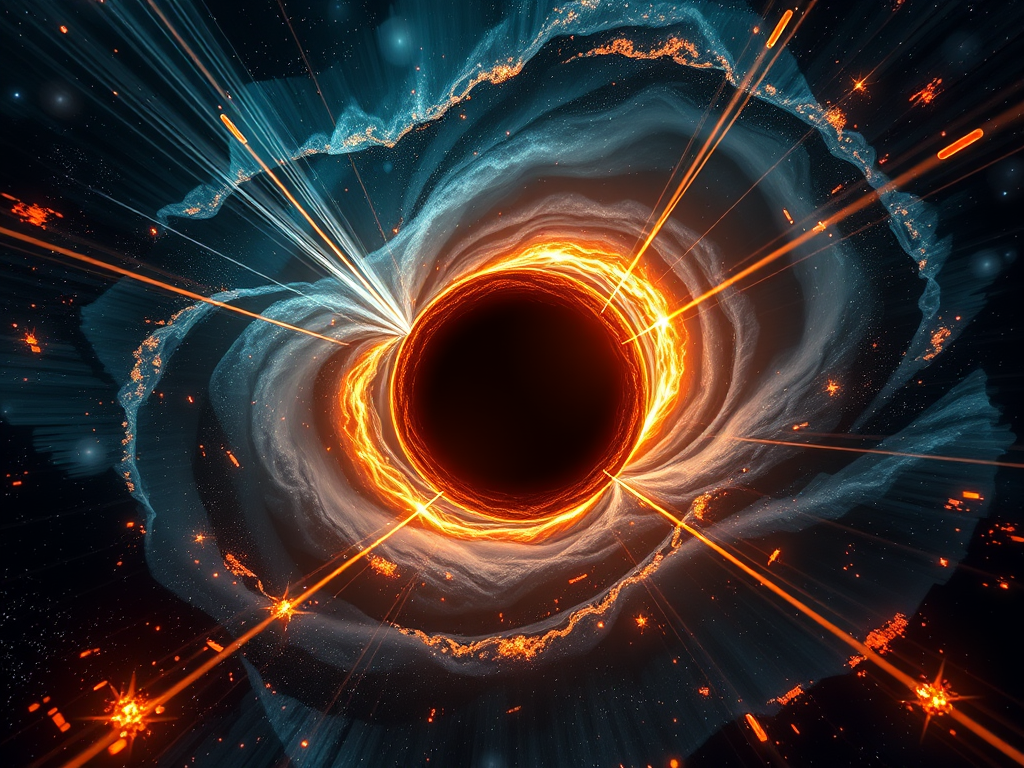
Black holes are regulators of cosmic balance. They absorb gas, dust, stars, and radiation, but they also release powerful energy through jets and radiation bursts. This constant cycle of intake and release shapes galaxies and influences their growth.
At the core of most galaxies, including our Milky Way, lies a supermassive black hole. It affects the behavior of stars and gases around it, preventing galaxies from collapsing under their own weight. Instead of chaos, black holes create equilibrium.
Recycling of Matter and Energy
Matter that falls toward a black hole is not lost forever. According to Einstein’s theory of relativity, energy cannot be destroyed; it only changes form.
As material approaches the event horizon, gravity and heat break it apart. Some of it is absorbed, while some is released as powerful radiation and jets. These emissions travel across space, helping to form new stars, nebulae, and galaxies.
In this way, the material from a dying star may one day become part of a new one. The black hole acts as a recycling center, turning destruction into creation.
Black Holes as Star Makers
Observations from advanced telescopes like the Chandra X-ray Observatory and James Webb Space Telescope show that the regions around black holes are full of activity. They are not dead zones but birthplaces of new stars.
When matter spirals toward a black hole, it heats up and creates enormous pressure. This energy compresses nearby gas clouds, setting off the process of star formation. The same force that swallows matter also powers the birth of new celestial bodies.
Black holes serve as both destroyers and creators. They end one form of existence and prepare the universe for another.
The Recycling Metaphor
The idea of black holes as “recycling bins of the universe” fits because they collect cosmic debris and transform it into fresh energy and structure.
In simple terms:
- Old stars collapse and form black holes.
- Black holes release energy and radiation.
- That energy becomes the seed for new stars and galaxies.
This ongoing cycle keeps the universe alive and evolving. Without black holes, galaxies would lack the structure and renewal that sustain cosmic balance.
Black holes are not the end of matter but part of a grand cycle of transformation. They break down old material and redistribute it into new forms. Through this process, the universe keeps expanding, creating, and balancing itself.
Calling black holes “the universe’s recycling bins” is not poetic exaggeration but scientific truth. They collect the remnants of the old universe and return them as the building blocks of the new.
FAQs
Can black holes help form new stars?
Yes, energy released near black holes can compress gas clouds and trigger new star formation.
Can black holes destroy galaxies completely?
No, they regulate galaxies by balancing matter and energy rather than destroying them.
Can light escape a black hole?
No, light cannot escape once it crosses the event horizon, but energy can be released before that point.
Can black holes grow larger?
Yes, they expand as they absorb more matter and energy from their surroundings.
Can black holes vanish?
Yes, over billions of years, small black holes slowly lose energy through a process known as Hawking radiation.
Author


Discover more from Southwala
Subscribe to get the latest posts sent to your email.