Southwala Shorts
- Once upon a time in Mount Kailash, Goddess Parvati prepared sandalwood paste to bathe.
- From that paste she shaped a little boy and, with her divine power, breathed life into him.
- This boy was Ganesha.
- Parvati adored him and declared, “You are my son, you will guard me.” She sent him to stand at the entrance of her chambers.

The Birth of Ganesha
Once upon a time in Mount Kailash, Goddess Parvati prepared sandalwood paste to bathe. From that paste she shaped a little boy and, with her divine power, breathed life into him. This boy was Ganesha.
Parvati adored him and declared, “You are my son, you will guard me.” She sent him to stand at the entrance of her chambers.
When Lord Shiva returned and tried to enter, Ganesha stopped him. “Mother has said none may enter,” he said. Shiva grew angry — who was this child to stop him? After repeated arguments and battles, Shiva, in his fury, cut off Ganesha’s head.
When Parvati saw her son’s lifeless body, she wept in agony. Her sorrow turned to rage, and she threatened to destroy all creation. To calm her, Shiva promised to restore the boy. The gods searched and brought the head of a strong elephant. Shiva placed it on the boy’s body and gave him life again. Thus Ganesha was born anew, elephant-headed, blessed to be worshipped before all other gods, the remover of obstacles.
The Moon and the Curse
Another story connects Ganesh Chaturthi with the moon.
On one festival night, Ganesha had eaten a heavy meal of sweets, especially his favorite modaks. Riding back on his tiny mouse, his big belly caused the mouse to stumble. Ganesha fell.
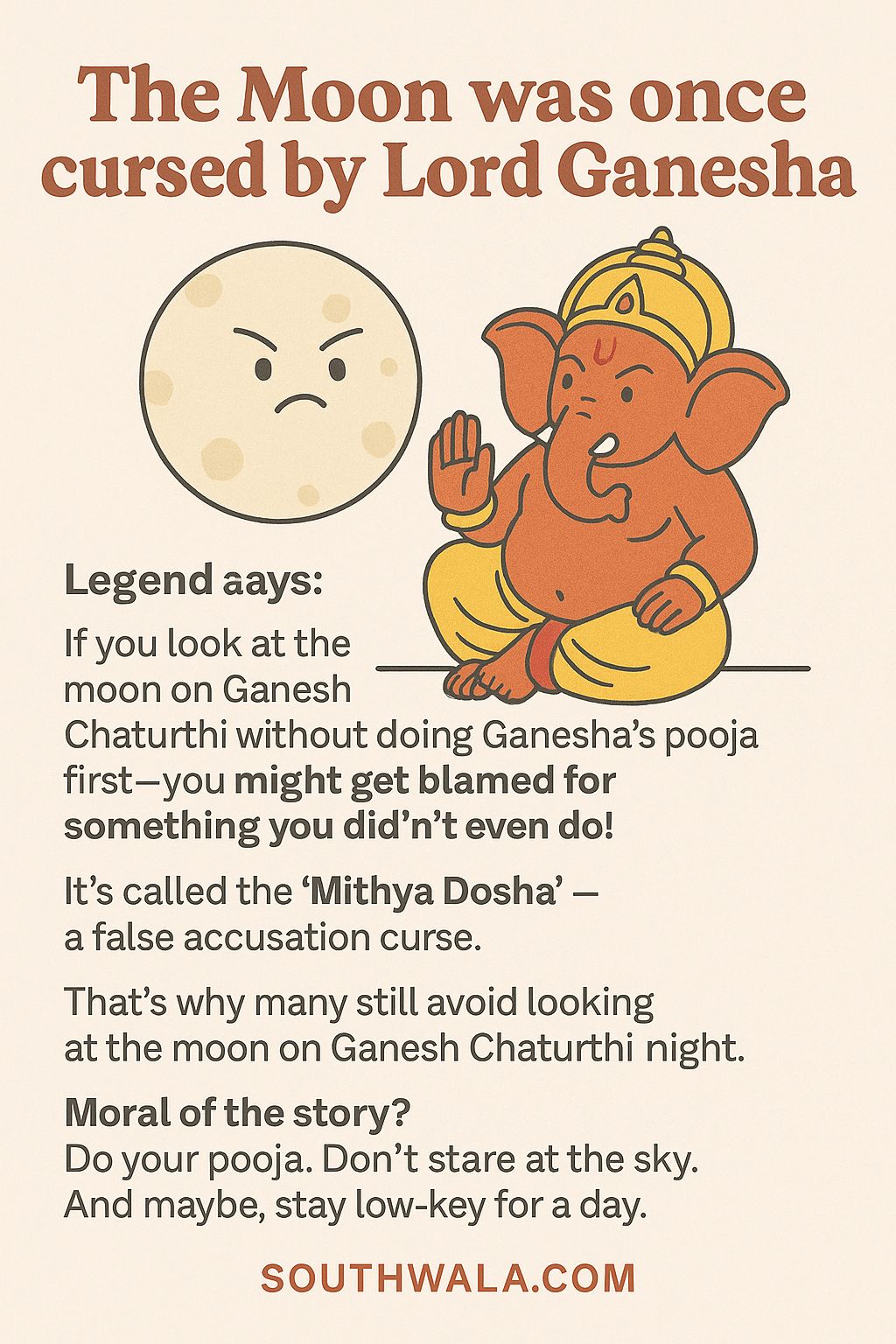
The moon, watching this scene, laughed aloud. Ganesha felt insulted and cursed: “On my day of worship, whoever looks at you will face Mithya Dosha — they will be falsely accused of wrongdoings.”
This is why on Ganesh Chaturthi, devotees avoid looking at the moon during certain hours.
Why Samanthakamani is Remembered Here
The curse of Mithya Dosha became deeply rooted in Hindu lore. A famous example is the Samanthakamani (Syamantaka Jewel) story in the Bhagavata Purana.
The legend says that when Lord Krishna was falsely accused of stealing the precious jewel Samanthakamani, people remembered the curse of Ganesha. It was believed that whoever saw the moon on Ganesh Chaturthi would suffer false accusations — and Krishna himself became an example of this curse at play.
Krishna eventually proved his innocence by recovering the jewel and clearing his name, but the story is always cited as a living proof of why Ganesha’s curse is real and why one must avoid seeing the moon on Chaturthi night.
So when families tell the Ganesh Chaturthi story, they often add the Samanthakamani example to explain how even great beings like Krishna were not spared from Mithya Dosha.
The Meaning Behind the Festival
- The Idol’s Arrival: Welcoming Ganesha into homes and pandals is like welcoming wisdom, humility, and courage into our lives.
- The Modak: Symbolizes the sweet reward of hard work and devotion.
- The Visarjan: The immersion of the idol is a reminder that everything in this world is temporary — only the spirit and values remain.
- The Moon Lesson: Teaches us not to laugh at others’ misfortune or take pride in mocking, because it may bring us karmic consequences.
Why We Read This Story During the Festival
Reading or narrating Ganesha’s story during Ganesh Chaturthi is not just ritual — it’s reflection. The birth story teaches us about creation and destruction, the moon story warns us against arrogance, and the Samanthakamani connection proves that divine justice and truth always prevail.
It is why families, especially in South India and Maharashtra, gather children and elders together to retell these tales — to pass on wisdom through stories.
Ganesh Chaturthi is not only about celebrating with songs, modaks, and decorations. It is about remembering these stories: the boy who stood for duty, the god who taught us humility, and the legend that warns us about false pride.
When we say “Ganpati Bappa Morya”, we don’t just call upon him for blessings — we remind ourselves to live with wisdom, focus, and kindness.
Author


Discover more from Southwala
Subscribe to get the latest posts sent to your email.