Southwala Shorts
- Fighter jets are symbols of power and cutting-edge engineering.
- They are not just machines of war, but also representations of national strength and technological progress.
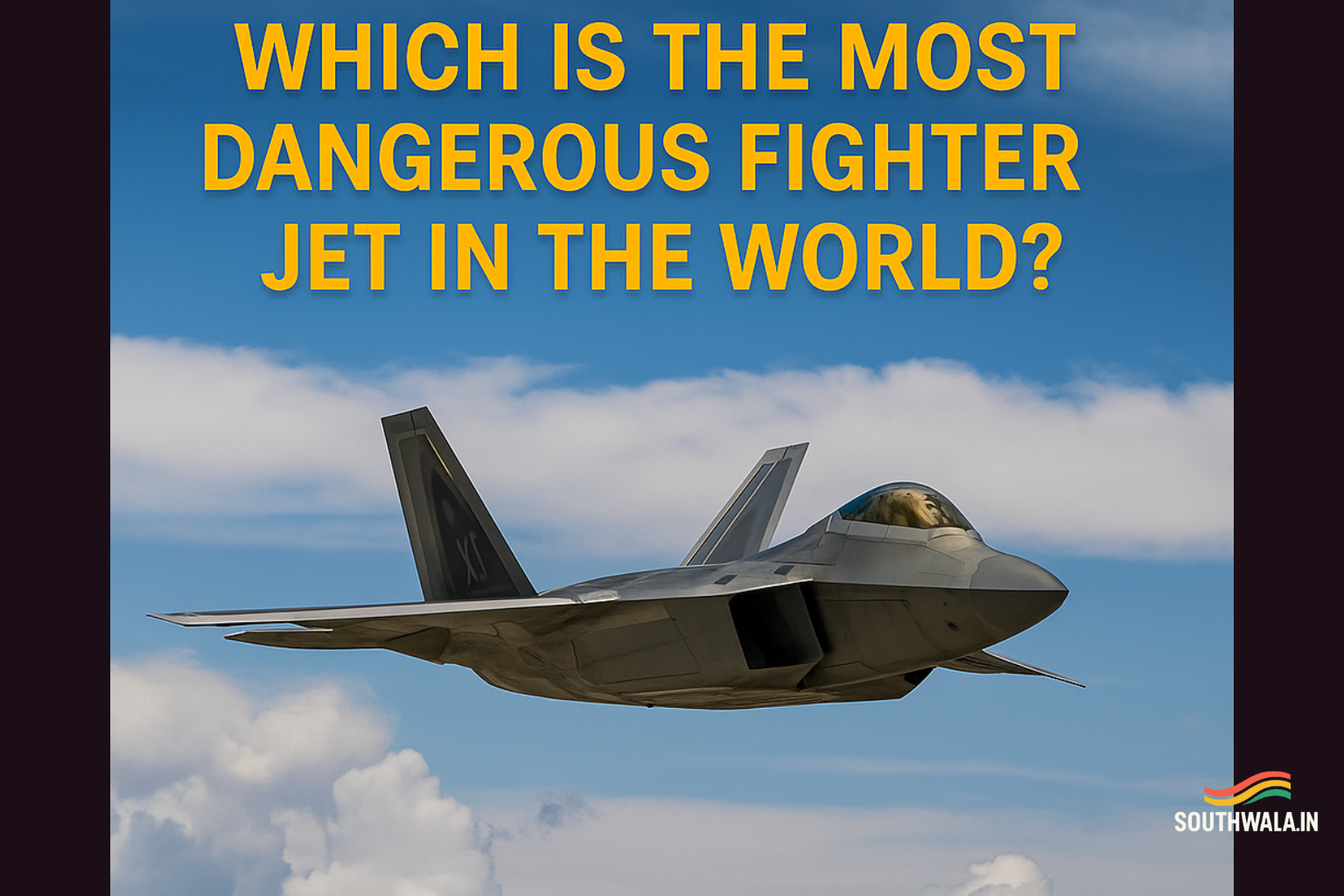
- When people ask, “Which is the most dangerous fighter jet in the world?” they are asking which aircraft dominates the skies with stealth, speed, and...
- Among all modern jets, one name consistently stands at the top: the Lockheed Martin F-22 Raptor of the United States Air Force.

Fighter jets are symbols of power and cutting-edge engineering. They are not just machines of war, but also representations of national strength and technological progress. When people ask, “Which is the most dangerous fighter jet in the world?” they are asking which aircraft dominates the skies with stealth, speed, and survivability.
Among all modern jets, one name consistently stands at the top: the Lockheed Martin F-22 Raptor of the United States Air Force. Let us explore why it holds this reputation, how it compares with rivals, and what makes it truly “dangerous” in modern warfare.
Defining “Dangerous” in Air Combat
“Dangerous” is not about looking aggressive or carrying the most missiles. It is about real combat effectiveness. Several key factors define a jet’s danger level:
- Stealth: the ability to avoid radar and infrared detection.
- Supercruise: flying at supersonic speeds without afterburners.
- Agility: sharp turns, quick climbs, and maneuverability in dogfights.
- Avionics and Sensors: advanced radar, electronic warfare, and sensor fusion.
- Weapons Load: the balance between air-to-air and air-to-ground weapons.
- Survivability: how well it can evade threats and withstand combat situations.
When these factors are compared, the F-22 Raptor emerges as the most lethal and balanced jet.
The F-22 Raptor: King of the Skies
The Lockheed Martin F-22 Raptor is a fifth-generation stealth fighter, first introduced in 2005. Built exclusively for the U.S. Air Force, it was designed as an air superiority fighter with strike capabilities.
Key Features
- Stealth Superiority
The F-22 has one of the lowest radar signatures of any aircraft. Its shape, materials, and internal weapons bays allow it to remain hidden while tracking and striking targets. - Supercruise Speed
It can cruise at supersonic speeds without afterburners. This saves fuel, reduces heat signature, and allows faster response. - Unmatched Agility
With thrust-vectoring nozzles and an advanced aerodynamic design, the Raptor can perform maneuvers that few aircraft can match. - Advanced Avionics
Its sensor fusion allows the pilot to see a complete picture of the battlefield. It can detect enemies before being detected. - Survivability
Combining stealth, speed, and agility makes the Raptor extremely hard to target. In simulated combat exercises, it has repeatedly shown dominance.
Rivals on the Global Stage
Though the F-22 is often called the most dangerous, several rivals deserve mention.
Su-57 (Russia)
Russia’s first operational stealth fighter, the Sukhoi Su-57, is designed to compete with U.S. fifth-generation jets.
- It has stealth shaping, advanced avionics, and supermaneuverability.
- However, production numbers are low and its systems are still being refined.
F-35 Lightning II (United States)
The F-35 is another American fifth-generation fighter. Unlike the F-22, it was built for multirole flexibility, air combat, strike missions, and intelligence gathering.
- It excels in networking and battlefield connectivity.
- In a pure air-to-air duel, the F-22 remains superior, but the F-35 is more versatile.
Su-35 (Russia)
The Sukhoi Su-35 is not stealth but is famous for its agility. Its thrust-vectoring engines allow dramatic maneuvers that give it an edge in close combat.
- Still, its lack of stealth makes it more vulnerable in long-range engagements.
Why the F-22 Stands Apart
When compared across categories, the F-22 blends all the key qualities better than any other jet.
- It can strike first because of stealth.
- It can escape or chase with supercruise.
- It can dominate in a dogfight with agility.
- It provides its pilot with unmatched awareness with sensor fusion.
This combination makes it not just a good fighter, but the benchmark for modern aerial combat.
Limitations of the F-22
No fighter jet is without flaws:
- Limited Production: Only about 187 F-22s were built, and the line has been closed.
- High Maintenance Costs: Its stealth coatings and advanced systems are expensive to maintain.
- Aging Design: Though still lethal, newer sixth-generation fighters are in development.
Even with these limits, its combat reputation remains unmatched.
Comparing Top Fighters
| Jet | Strengths | Weaknesses |
|---|---|---|
| F-22 Raptor (US) | Stealth, supercruise, agility, advanced avionics | Limited numbers, high cost |
| Su-57 (Russia) | Stealth + agility, modern avionics | Few built, ongoing development |
| F-35 Lightning II (US) | Multirole, advanced networking | Less agile in air-to-air than F-22 |
| Su-35 (Russia) | Extreme maneuverability, powerful engines | No stealth, more visible to radar |
Real-World Combat Relevance
In modern warfare, the side that sees first and shoots first often wins. That is why stealth and sensor fusion matter more than pure speed.
- The F-22 gives pilots the ability to engage enemies before being detected.
- In training exercises, Raptors have often scored overwhelming victories over advanced fourth-generation jets.
- Its role is not only to dominate airspace but also to protect allied aircraft by eliminating threats early.
FAQs about Which Is the Most Dangerous Fighter Jet in the World
1. Is the F-22 still active?
Yes. It continues to serve as the U.S. Air Force’s frontline air superiority fighter.
2. Why is the F-22 more dangerous than the F-35?
The F-22 is dedicated to air dominance, while the F-35 is a multirole jet. In pure combat, the F-22 has better stealth and agility.
3. How many countries fly the F-22?
Only the United States. It has never been exported due to its sensitive technology.
4. Can the Su-57 compete with the F-22?
On paper, the Su-57 has impressive features. But with limited numbers and ongoing development, it has not yet proven equal to the F-22 in operational use.
5. What comes after the F-22?
The U.S. is working on a sixth-generation program called NGAD (Next Generation Air Dominance). Until then, the F-22 remains unmatched.
Author


Discover more from Southwala
Subscribe to get the latest posts sent to your email.