Southwala Shorts
- Every time you open your maps app and see the blinking blue dot, you might wonder how your phone knows where you are.
- The answer lies not in your phone itself but in the sky.
- Orbiting Earth are dozens of satellites, all part of the Global Positioning System, better known as GPS.
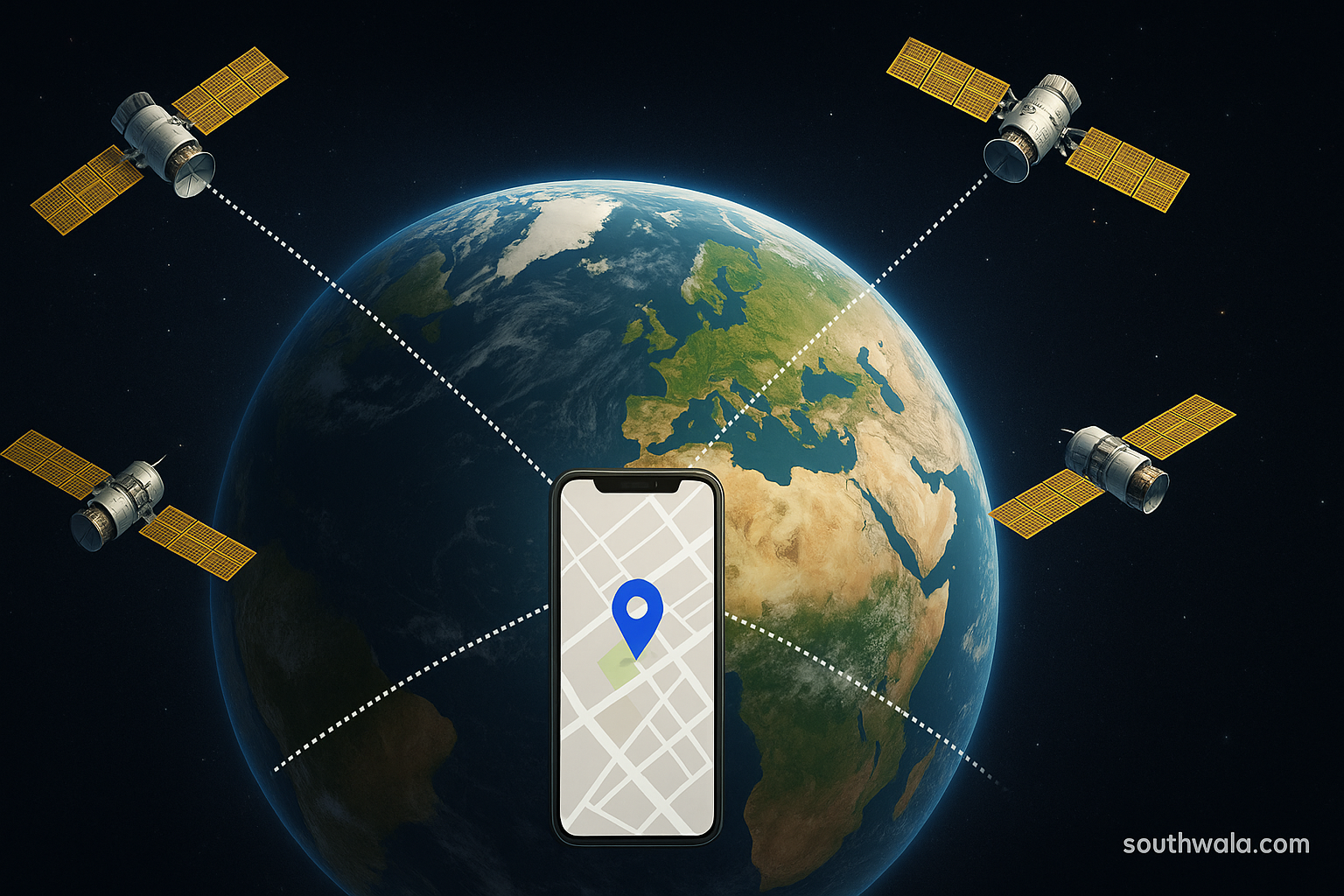
- At any given moment, at least four satellites are talking to your phone.

Every time you open your maps app and see the blinking blue dot, you might wonder how your phone knows where you are. The answer lies not in your phone itself but in the sky. Orbiting Earth are dozens of satellites, all part of the Global Positioning System, better known as GPS.
How Satellites Send the Signal
At any given moment, at least four satellites are talking to your phone. They send radio signals that travel at the speed of light. Your phone is like a listener that measures how long it takes for those signals to arrive. Since the signals from each satellite reach at slightly different times, the phone can calculate exactly how far it is from each one.
Triangulation in Action
Imagine standing in a park while three friends point towards you from different corners. Where their lines meet is your position. GPS works the same way, but instead of friends, satellites are pointing at you from space. When at least three or four satellites agree, the system can lock your spot on Earth with surprising accuracy.
The Role of Timing
Accuracy comes down to timing. Each satellite carries an atomic clock, which is incredibly precise. Your phone has a smaller, less accurate clock. To avoid mistakes, your phone keeps checking differences in timing with multiple satellites. This helps fix errors and places you almost exactly where you stand.
Why GPS is So Accurate Today
Modern phones do not just use the American GPS system. They also connect to other satellite networks like GLONASS from Russia, Galileo from Europe, and NavIC from India. This teamwork makes your location stronger, faster, and more precise, even in crowded cities or remote areas.
Beyond Directions
GPS is not just about finding the nearest café. Farmers use it for precision agriculture, airplanes use it to land safely, and scientists use it to study earthquakes. Your fitness tracker uses GPS to count your morning jog route, and emergency services rely on it to find people quickly.
The Limits You Should Know
Even with all this power, GPS can face problems. Tall buildings, tunnels, or dense forests can block signals. That is why your map sometimes shows you walking a few meters away from the road. To solve this, phones often combine GPS with Wi-Fi and mobile towers for better results.
FAQs
1. Can GPS work without the internet?
Yes, GPS works through satellites, not the internet. But apps may need data to download maps.
2. How close can GPS track me?
Usually within 5 to 10 meters. With advanced tools, accuracy can be just a few centimeters.
3. Why does my GPS get confused sometimes?
Signals may bounce off tall buildings or get weak in tunnels and dense areas.
4. Does GPS track me all the time?
No, GPS itself does not track you. Apps that use GPS may store your location if you allow them.
5. Who controls GPS satellites?
The United States government maintains them, but anyone in the world can use the signals freely.
Author


Discover more from Southwala
Subscribe to get the latest posts sent to your email.