Southwala Shorts
- Trimbakeshwar Shiva Temple stands as one of India’s most sacred Jyotirlingas, resting in the lap of the Brahmagiri Hills near Nashik, Maharashtra.
- This temple is not only a center of deep spiritual significance but also a masterpiece of ancient architecture and symbolism.
- It is a rare place where faith, geology, and cosmic philosophy merge seamlessly, making it a pilgrimage unlike any other.
- Trimbakeshwar lies at the origin of the Godavari River, one of India’s holiest and longest rivers.

Trimbakeshwar Shiva Temple stands as one of India’s most sacred Jyotirlingas, resting in the lap of the Brahmagiri Hills near Nashik, Maharashtra. This temple is not only a center of deep spiritual significance but also a masterpiece of ancient architecture and symbolism. It is a rare place where faith, geology, and cosmic philosophy merge seamlessly, making it a pilgrimage unlike any other.
The Sacred Location and Its Significance
Trimbakeshwar lies at the origin of the Godavari River, one of India’s holiest and longest rivers. The location itself represents the union of life-giving elements like water, earth, and divinity. The surrounding Brahmagiri Hills are believed to be where Lord Shiva resides eternally, blessing the river that nourishes millions across India.
The name “Trimbakeshwar” comes from “Trimbak,” meaning three-eyed, referring to Lord Shiva’s threefold vision of creation, preservation, and destruction. The temple is not just a monument; it is seen as a living embodiment of cosmic energy.
The Architectural Brilliance
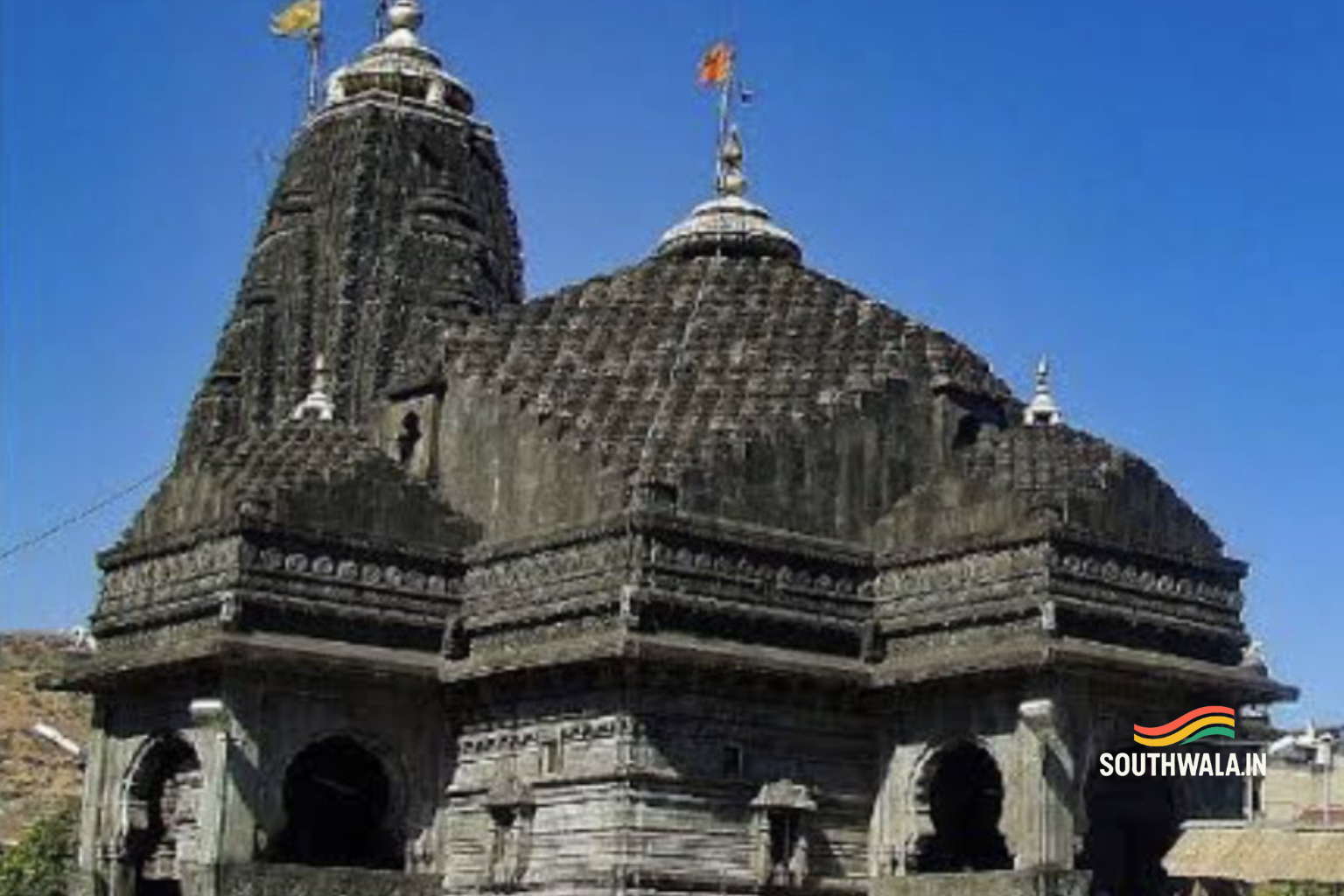
Built by Peshwa Balaji Baji Rao in the 18th century, the temple showcases classic Nagara-style architecture crafted entirely from black basalt stone. Its structure reflects balance and symmetry, with intricate carvings of gods, saints, and mythical creatures adorning its walls.
The temple’s most striking feature is its Shivlinga, which is not like any other in India. It represents the Trimurti Brahma, Vishnu, and Shiva, three heads symbolizing creation, preservation, and transformation. Uniquely, this Shivlinga is eroding gradually due to constant water flow, a natural phenomenon that devotees interpret as a sign of divine energy manifesting through nature.
The temple’s sanctum remains perpetually moist, symbolizing the eternal flow of consciousness. It reminds devotees that the divine is not static but alive and breathing within the rhythm of time.
The Mythological Story Behind Trimbakeshwar
Ancient texts say that the sage Gautama and his wife Ahalya once lived near this region. After accidentally causing a cow’s death, Gautama prayed for purification. Lord Shiva, moved by his devotion, released the river Godavari from the Brahmagiri Hills to wash away the sin. To bless the land further, Shiva established himself here as Trimbakeshwar.
This legend made the temple not just a center of worship but also a site of penance and renewal. The flowing Godavari became the symbol of forgiveness, and Trimbakeshwar became the gateway to liberation.
The Spiritual Science of Trimbakeshwar
Trimbakeshwar holds special importance in Hindu ritual science. It is one of the few temples where the Narayan Nagbali Puja is performed, a powerful ritual believed to free souls trapped by ancestral karma. Pilgrims from across India visit the temple to perform this ceremony to ensure peace for their forefathers.
Another unique ritual performed here is the Kaal Sarp Dosh Nivaran Puja, meant to neutralize planetary imbalances caused by Rahu and Ketu in one’s horoscope. Priests trained in Vedic traditions guide devotees through these ancient rites, blending astronomy, astrology, and spirituality.
The temple thus serves as both a physical and metaphysical center, a place where human life, cosmic forces, and ancestral connections intersect.
The Symbolism of the Three Faces
The three faces of the Shivlinga hold profound meaning. They symbolize the cyclical nature of existence Brahma representing birth, Vishnu representing sustenance, and Shiva representing transformation. Together, they convey the truth that creation is an ongoing process, not a single act.
For devotees, meditating on the three forms helps transcend duality, joy and sorrow, life and death, and gain and loss. Trimbakeshwar becomes a mirror through which one sees that divinity is not outside but within every heartbeat.
The River Godavari and Its Spiritual Flow
The Godavari River, known as the Ganga of the South, begins its journey at Trimbakeshwar. Its emergence from the Brahmagiri Hills is seen as a divine act. Bathing in the Kushavarta Kund, a sacred tank near the temple, is believed to purify the body and the mind.
Every twelve years, Trimbakeshwar becomes one of the four locations of the Kumbh Mela, the largest spiritual gathering on Earth. Millions gather here to bathe in the Godavari, believing that the river carries the nectar of immortality. The temple thus connects personal devotion with cosmic celebration.
The Living Traditions and Priestly Lineage
The temple’s rituals are performed by priests known as Tembes and Purohits, who belong to families that have served the temple for generations. Each ritual is carried out according to ancient Agamic texts, maintaining the continuity of tradition that dates back over two millennia.
Daily worship begins early morning with Abhishekam using milk, water, honey, and bilva leaves. The chanting of mantras fills the air, creating a vibrational field that devotees describe as deeply meditative. The energy inside the sanctum is intense, often described as grounding and purifying.
The Philosophy Hidden in Stone
The erosion of the Shivlinga is symbolic of time itself. As centuries pass, even the divine form transforms, reminding humanity that permanence lies only in spirit, not in matter. Trimbakeshwar thus stands as a philosophical statement that the sacred is not about preservation but participation in the eternal cycle of change.
The Message of Trimbakeshwar in Modern Times
In today’s fast-moving world, Trimbakeshwar continues to draw seekers who wish to reconnect with silence and meaning. It represents a balance between material and spiritual life, between worship and wisdom.
Visitors leave the temple not just with religious satisfaction but with a deeper sense of perspective that faith is not blind belief, but awareness of the forces that sustain life.
Trimbakeshwar teaches that divinity exists in constant motion, flowing like the Godavari humble, powerful, and unending.
Frequently Asked Questions
Why is Trimbakeshwar considered special among Jyotirlingas?
It is the only Jyotirlinga representing the three forms of divine energy, Brahma, Vishnu, and Shiva, in a single sanctum.
Is there a scientific reason behind the temple’s constant moisture?
The sanctum lies near natural underground springs connected to the Godavari’s source, which keeps the inner chamber continuously damp.
Why is the Narayan Nagbali Puja performed here?
The temple is believed to be spiritually powerful for resolving ancestral and karmic issues, making it ideal for this rare ritual.
Can non-Hindus visit the temple?
Yes, visitors of all backgrounds may enter the outer complex, though the main sanctum’s rituals are performed by authorized priests only.
Does visiting Trimbakeshwar have spiritual benefits?
Pilgrims believe the visit purifies karmic debts, balances life energies, and brings inner peace through connection with the source of divine consciousness.
Author


Discover more from Southwala
Subscribe to get the latest posts sent to your email.