
Southwala Shorts
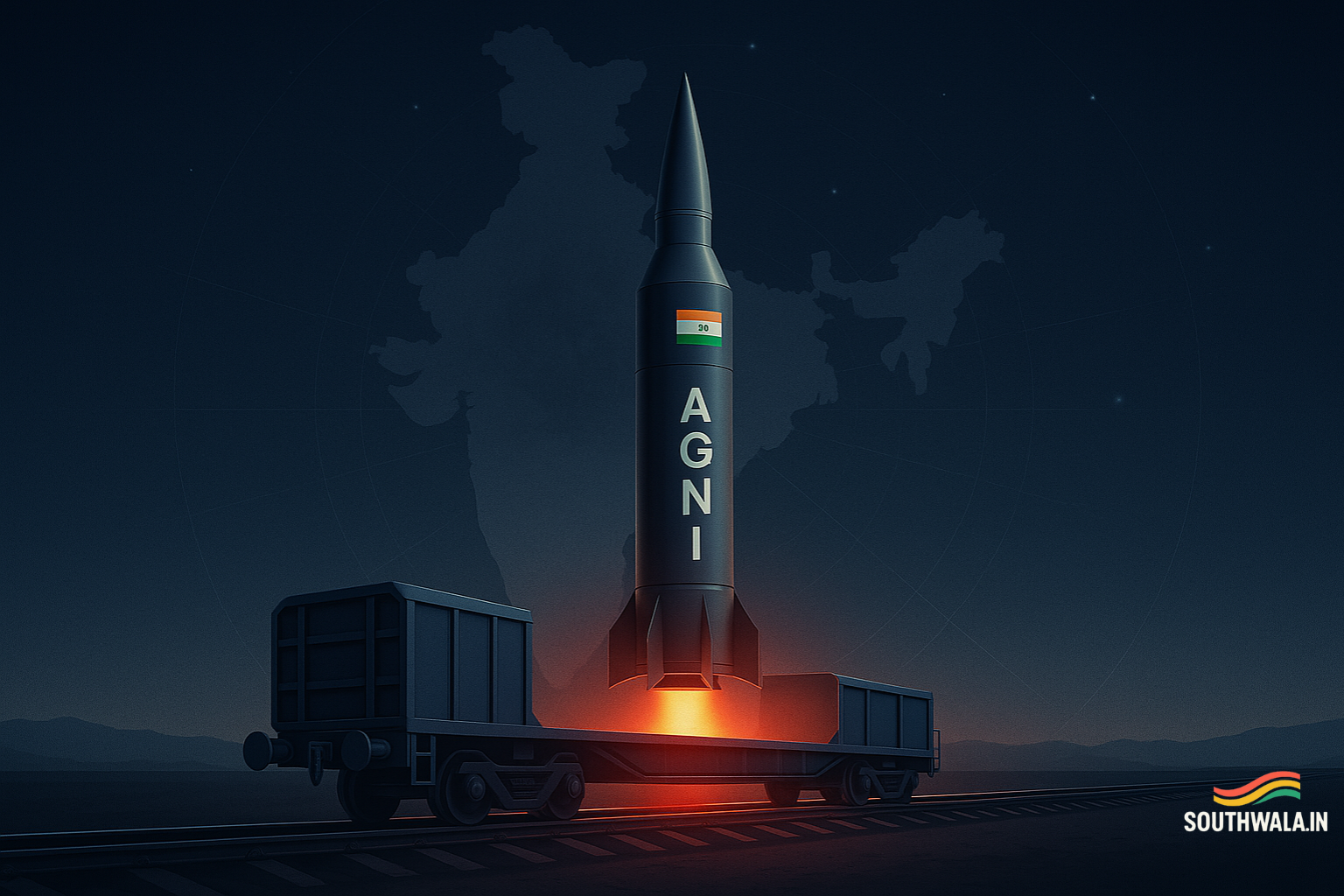
- India has successfully tested the Agni-Prime, a nuclear-capable ballistic missile with a range of 2,000 kilometers, from a rail-based mobile launcher system.
- The launch highlights a significant advancement in India’s missile deployment strategy, offering greater flexibility and survivability in times of conflict.
- A rail-based mobile launcher allows missiles to be fired from trains instead of fixed launch pads.
- This provides strategic advantages, including the ability to move launchers across the country, making them harder to detect and target.

India has successfully tested the Agni-Prime, a nuclear-capable ballistic missile with a range of 2,000 kilometers, from a rail-based mobile launcher system. The launch highlights a significant advancement in India’s missile deployment strategy, offering greater flexibility and survivability in times of conflict.
A rail-based mobile launcher allows missiles to be fired from trains instead of fixed launch pads. This provides strategic advantages, including the ability to move launchers across the country, making them harder to detect and target. With rail mobility, India can disperse its missile assets over vast areas, ensuring stronger deterrence against potential threats.
The Agni-Prime is part of India’s Agni series of ballistic missiles, developed by the Defence Research and Development Organisation (DRDO). It is a medium-range missile, capable of striking targets up to 2,000 kilometers away. The missile is lighter and more advanced than its predecessors, with modern guidance systems and improved accuracy.
By integrating the Agni-Prime with a rail-based launch system, India strengthens its second-strike capability. This means that even in the event of a first strike by an adversary, India’s ability to retaliate remains secure. The system enhances survivability, mobility, and readiness, key elements of a credible nuclear deterrent.
Unlike traditional silo or road-based launchers, rail launchers combine mobility with the ability to carry heavy payloads. India’s vast railway network provides a natural advantage, allowing launch units to be positioned discreetly across the country. This reduces predictability and complicates enemy surveillance.
The test of the Agni-Prime missile from a train-based launcher marks an important milestone in India’s defense modernization. Experts believe that such developments reflect India’s focus on strengthening its strategic capabilities while maintaining a credible minimum deterrence policy.
The successful trial underscores India’s growing technological edge and its ability to secure its defense interests in an evolving security environment.
Author


Discover more from Southwala
Subscribe to get the latest posts sent to your email.

