
Southwala Shorts
- An Electronic Voting Machine or EVM is a device developed by the Election Commission of India to make voting faster, more reliable, and free from...
- It was introduced in Indian elections in a limited way in the 1990s and is now used in all Lok Sabha and state assembly elections.
- Unlike online voting systems, the EVM is completely offline.
- It is not connected to the internet or any external network, which eliminates the risk of hacking from remote locations.

Highlights
- EVM is a standalone electronic device used to record votes in Indian elections
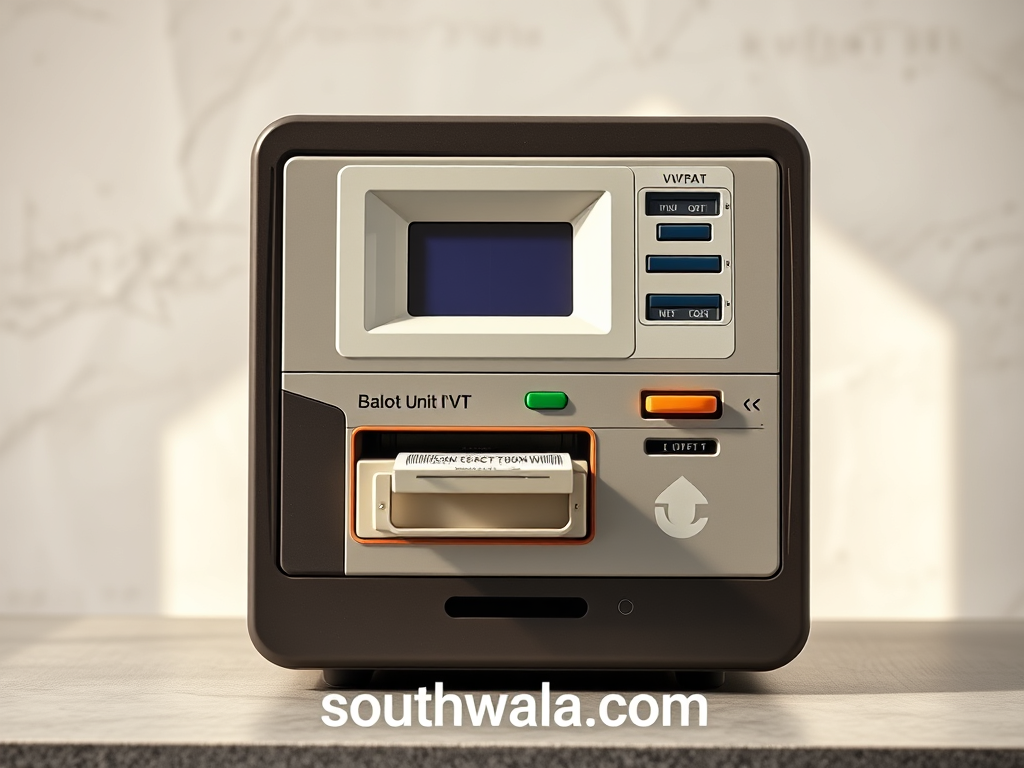
- It consists of two main units: the Ballot Unit and the Control Unit, sometimes with an added VVPAT system
- Votes are stored securely inside the machine and are not connected to the internet
- Counting is done electronically and results are displayed within minutes once the control unit is unlocked
- Multiple safeguards ensure that the machine cannot be tampered with during voting or transport
What is an EVM
An Electronic Voting Machine or EVM is a device developed by the Election Commission of India to make voting faster, more reliable, and free from manual counting errors. It was introduced in Indian elections in a limited way in the 1990s and is now used in all Lok Sabha and state assembly elections.
Unlike online voting systems, the EVM is completely offline. It is not connected to the internet or any external network, which eliminates the risk of hacking from remote locations.
The Components of an EVM
An EVM has three main parts:
- Ballot Unit (BU)
- This is the part the voter interacts with
- It contains buttons corresponding to each candidate’s name and election symbol
- It is placed inside the voting compartment where the voter presses their choice in privacy
- Control Unit (CU)
- Operated by the polling officer
- Stores the actual votes
- Controls the functioning of the Ballot Unit
- Can only be activated for voting when the officer presses the “Ballot” button for the next voter
- VVPAT (Voter Verified Paper Audit Trail) – introduced in recent years for transparency
- Prints a slip showing the voter’s choice
- The slip is visible to the voter through a glass window for a few seconds before falling into a sealed box
- Used for verification during random vote audits after polling
How the Voting Process Works – Step by Step
1. Preparing the Machine Before Voting Day
- Before polling, the EVMs are checked and sealed in the presence of representatives from all political parties
- The machines are tested to confirm that each button correctly records the vote for the assigned candidate
- After testing, the machine’s memory is cleared so it starts fresh with zero votes
- Unique serial numbers are recorded and shared with party agents
2. Voter Arrives at the Booth
- The voter’s identity is verified through the electoral roll and ID proof
- Once verified, the polling officer presses the “Ballot” button on the Control Unit
- This enables the Ballot Unit for the next vote
3. Casting the Vote
- The voter enters the compartment and presses the button next to their chosen candidate’s symbol
- A red light near the button glows and a beep sound is heard, confirming that the vote is recorded
- If VVPAT is present, the paper slip with candidate name and symbol appears for 7 seconds before falling into the sealed box
4. Storing the Vote
- The vote is stored in the Control Unit’s memory
- Each Control Unit can store up to 2,000 votes (newer models can store more)
- No one can see the stored votes during polling, not even polling officers
How Data Flows Inside the EVM
- The moment the button is pressed, the Ballot Unit sends a coded electrical signal to the Control Unit
- The Control Unit interprets this signal and adds one vote to the internal count for that specific candidate
- This process is instantaneous and happens through physical cable connection between the units
- The memory chip in the Control Unit keeps a secure tally without revealing it until counting day
Security Measures and Safeguards
- No Internet or Wireless Connectivity
The EVM is a closed circuit system with no capability to connect to external devices or networks. - One Vote per Activation
The Ballot Unit records only one vote each time it is enabled by the Control Unit. This prevents multiple votes being cast accidentally or intentionally. - Seals and Signatures
After preparation, the machines are sealed with paper seals signed by party agents. Breaking a seal without permission is considered a serious violation. - Strong Physical Security
EVMs are transported in secure boxes and guarded by police and election officials until counting day. - Randomisation Process
Machines are randomly assigned to constituencies to prevent any prior knowledge of which machine will be used where.
The Counting Process
On counting day, the EVMs are brought to the counting center under strict security. The process works as follows:
- The seals are checked in the presence of candidates’ representatives.
- Once verified, the Control Unit is connected to a display unit.
- The returning officer presses the “Result” button, which shows the total votes polled for each candidate.
- The results are recorded in official documents and signed by party agents.
- In constituencies with VVPAT, slips from randomly selected machines are counted and matched with electronic results to verify accuracy.
The entire counting process takes minutes per machine compared to hours for manual counting in the old paper ballot system.
Common Misconceptions
- EVMs can be hacked remotely – They cannot, because they have no wireless or internet connectivity.
- EVMs store votes in sequence – They store only totals for each candidate, not the order of votes.
- VVPATs slow down voting – They add only a few seconds and greatly improve transparency.
Why EVMs Matter
EVMs have reduced the time, cost, and disputes in Indian elections. Counting that once took days now finishes in hours. The risk of invalid or wrongly marked ballots has been eliminated. With VVPATs, there is also a paper trail for verification, striking a balance between speed and accountability.
FAQs About EVM Machines
- Can an EVM be tampered with before voting day?
No, because machines are sealed, signed by party agents, and stored securely after public testing. - What if an EVM malfunctions during voting?
It is immediately replaced with a reserve machine and the votes recorded until then are kept safe. - Do EVMs work without electricity?
Yes, they run on long-lasting batteries that can work for the entire polling day. - How many candidates can an EVM handle?
A single Ballot Unit handles up to 16 candidates, but more units can be linked if needed. - What is the role of VVPAT in counting?
It provides a physical verification method to cross-check electronic results in selected polling stations.
Author


Discover more from Southwala
Subscribe to get the latest posts sent to your email.

